
VeCASTER IPTV Encoders Review (2026)
In the world of professional IPTV broadcasting, relying on software for encoding is not always the best choice.
Hardware encoders offer greater stability, lower delay, and long-running performance for demanding settings.The VeCASTER IPTV Encoder series is a strong example of this.
Produced by ProVideo Instruments, the VeCASTER line is aimed at broadcasters, IPTV service providers, hotels, educational institutions, churches, businesses, and other organizations that need consistent 24/7 video streaming.
The HD HEVC model supports both H.265 (HEVC) and H.264 hardware encoding.This allows users to stream high-quality Full HD video while using less bandwidth.
Quick Verdict
| Category | Rating |
|---|---|
| Video Quality | ⭐⭐⭐⭐⭐ (5.0/5) |
| Hardware Reliability | ⭐⭐⭐⭐⭐ (4.9/5) |
| Streaming Features | ⭐⭐⭐⭐⭐ (4.8/5) |
| Ease of Configuration | ⭐⭐⭐⭐☆ (4.5/5) |
| Value for Enterprise | ⭐⭐⭐⭐☆ (4.6/5) |
| Overall Rating | 4.8/5 |
What Is the VeCASTER IPTV Encoder?
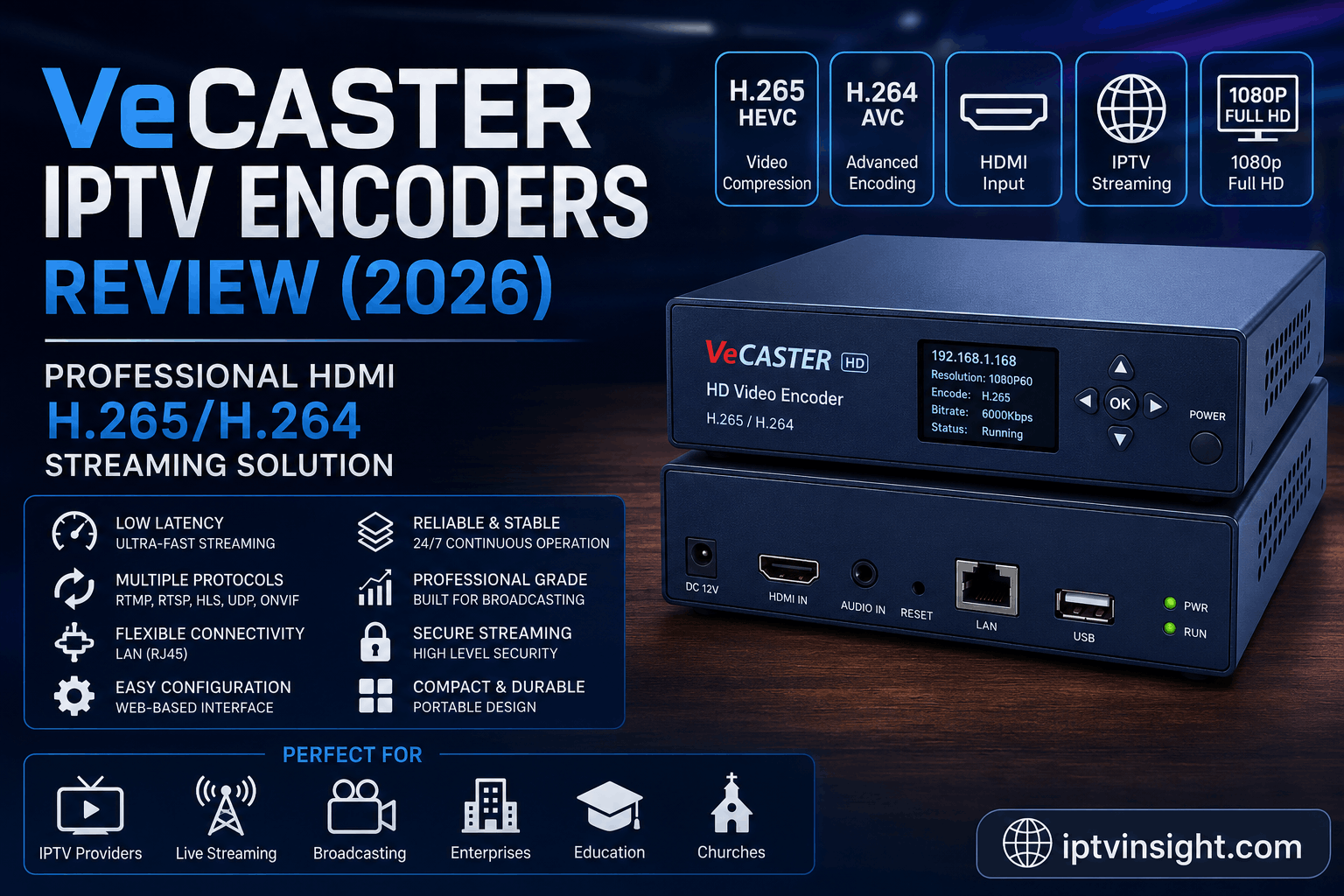
The VeCASTER HD HEVC is a professional single-channel HDMI IPTV hardware encoder that converts an HDMI video source into IP streams using hardware-based H.265 (HEVC) or H.264 compression.
Unlike streaming software that runs on a computer, the encoder operates independently.
This makes it ideal for continuous broadcasting without needing a separate machine.It can send streams to multiple locations and is built for long-term, uninterrupted use.
Key Features
H.265 (HEVC) & H.264 Encoding
The encoder supports both modern HEVC and traditional H.264 codecs.
HEVC can provide Full HD video at much lower bitrates, while H.264 offers full compatibility with older devices.
Dual Simultaneous Streams
Create two separate streams from a single HDMI input.
For example, you can stream a high-quality version for IPTV and a lower-bitrate version for mobile users simultaneously.
Multiple Streaming Protocols
The encoder supports:
- SRT
- RTMP & RTMPS
- HLS (M3U8)
- RTSP
- HTTP
- UDP/RTP
- SAP
- Unicast
- Multicast
This variety helps integrate with IPTV headends, CDNs, streaming servers, and OTT platforms.
Built-in Streaming Server
A built-in Gigabit hardware server enables direct streaming to compatible players and platforms without relying on additional software.
Logo & Watermark Support
The encoder offers multiple logo generators for adding branding and watermarks directly to the video stream.
Fan-less Industrial Design
Its metal, fan-less enclosure is designed for quiet operation and reliable 24/7 use in professional settings.
Technical Specifications
| Specification | Details |
|---|---|
| Video Input | 1× HDMI |
| Maximum Resolution | 1080p60 |
| Video Codec | H.265 (HEVC), H.264 |
| Audio Formats | AAC, MP3, MP2, AC3, PCM |
| Network | Gigabit Ethernet |
| Streaming Protocols | RTMP, HLS, RTSP, HTTP, UDP, RTP, SRT |
| Simultaneous Streams | 2 |
| Cooling | Fan-less |
| Warranty | 5 Years |
| Country of Manufacture | USA |
Performance Review
According to the official specs, the VeCASTER HD HEVC is made for professional broadcasting where dependable performance is important.
Hardware encoding reduces problems related to the CPU that often occur with software-based solutions, allowing for continuous operation.
Its HEVC implementation enables Full HD streaming from bitrates as low as around 250 kbps, making it suitable for networks with limited bandwidth, such as hotels, campuses, and remote sites.
The ability to produce two streams at once also allows for optimized delivery to different user groups simultaneously.
Supported Applications
The VeCASTER encoder is suitable for:
- IPTV providers
- Hotels & hospitality
- Educational institutions
- Houses of worship
- Digital signage
- Corporate video distribution
- Government facilities
- Live event streaming
- Broadcast contribution
- OTT content delivery
Installation & Setup
Setting up the encoder is done through a web-based management interface.
A typical setup includes:
1.
Connect an HDMI video source.
2.
Attach the encoder to the network using Gigabit Ethernet.
3.
Access the web interface.
4.
Choose your preferred codec (HEVC or H.264).
5.
Set the bitrate, resolution, and streaming protocol.
6.
Enter the details for the destination server or platform.
7.
Start broadcasting.
Pricing
At this time, the VeCASTER HD HEVC HDMI IPTV Encoder is priced at $895 USD (down from $995 USD), though prices may vary.
Pros
- Professional hardware encoding
- Support for both H.265 (HEVC) and H.264
- Excellent bandwidth efficiency
- Dual simultaneous streams
- Wide range of compatible protocols
- Built-in streaming server
- Fan-less industrial design
- 5-year warranty
- Free lifetime technical support
Cons
- Higher initial cost than software-based encoders
- Limited to a single HDMI input on this model
- Designed for professional use rather than casual users
Who Should Buy It?
The VeCASTER HD HEVC is a good choice for:
- IPTV operators
- Broadcast engineers
- Hotels
- Universities
- Churches
- Corporate AV departments
- Live streaming professionals
- Digital signage providers
It may not be the best option for home users or hobbyists who only stream occasionally.
Final Verdict
The VeCASTER HD HEVC IPTV Encoder is a professional-grade hardware solution built for reliability, performance, and flexibility.
With support for H.265 and H.264 encoding, dual simultaneous streams, extensive protocol compatibility, and a durable fan-less design, it is ideal for organizations needing dependable 24/7 IPTV or live streaming.
While its price is higher than that of basic encoders, the comprehensive feature set, long warranty, and professional design make it a strong investment for enterprise use.
Overall Rating: ⭐ 4.8/5
Frequently Asked Questions
Does VeCASTER support H.265 (HEVC)?
Yes.
The HD HEVC model supports both H.265 (HEVC) and H.264 hardware encoding.
Can it stream to YouTube or other platforms?
Yes.
It supports popular streaming protocols such as RTMP(S), HLS, SRT, RTSP, HTTP, and more.